KDP cream vs white paper
On KDP, cream vs white paper changes the spine. Cream adds 0.0025 in per page, while white adds 0.002252 in, so cream books are about 11% thicker. Cream suits novels, and white suits nonfiction, workbooks and books with images. Compare both spines in the calculator below.
By The Spinewrap team (Product and testing). Last updated .
| Measure | Inches | mm | 300 DPI |
|---|---|---|---|
| Full cover width (with bleed) | 13 in | 330.2 mm | 3900 px |
| Full cover height (with bleed) | 9.25 in | 235 mm | 2775 px |
| Spine width | 0.75 in | 19 mm | 225 px |
| Front and back cover width | 6 in | 152.4 mm | 1800 px |
| Trim height | 9 in | 228.6 mm | 2700 px |
| Bleed on each outside edge | 0.125 in | 3.2 mm | 38 px |
- Spine text is allowed at this page count.
How to compare cream vs white paper, step by step
- Enter your trim size and page count.
- Pick black ink on white paper and note the spine.
- Switch to black ink on cream paper and note the new spine.
- Choose the paper that fits your book type.
- Then download the template for the paper you chose.
The calculator and the templates are free. Print-ready covers and interiors come with 3 free proof runs a day; see the pricing page for clean files, or read how we check the KDP math.
Cream vs white paper: the look
Cream paper has a soft, warm tone. Many readers find it easier on the eyes for long reading, so most novels and memoirs use it. It also feels a little more like a bookstore paperback.
White paper, in contrast, gives sharp contrast for charts, photos and tables. So most nonfiction, textbooks, journals and workbooks use white. Also, color ink is only available on white paper on KDP.
How cream vs white paper changes your cover
Cream paper is thicker. For example, a 6 x 9 book with 300 pages has a 0.676 in spine on white and a 0.75 in spine on cream. That makes the full cover 0.074 in wider.
It sounds small. However, a cover made for white paper will fail on cream, since the fold lines land in the wrong place. Therefore, decide on the paper before you finish the cover, and make the template only after that.
Page limits and cost
Cream paper allows up to 776 pages, while white paper allows up to 828. So very long books may need white paper or a larger trim. Below those limits, KDP charges the same print cost for black ink on either paper.
Groundwood paper is a third option for some markets. It is a little thinner than cream, at 0.00235 in per page. Finally, if you change paper after launch, update both the cover file and the paper setting on KDP.
Cream vs white paper on KDP
| White paper | Cream paper | |
|---|---|---|
| Thickness per page | 0.002252 in | 0.0025 in |
| Spine at 300 pages | 0.6756 in | 0.75 in |
| Max pages | 828 | 776 |
| Color ink | Yes | No |
| Typical use | Nonfiction, workbooks | Fiction, memoir |
Cream vs white paper tested with a real book
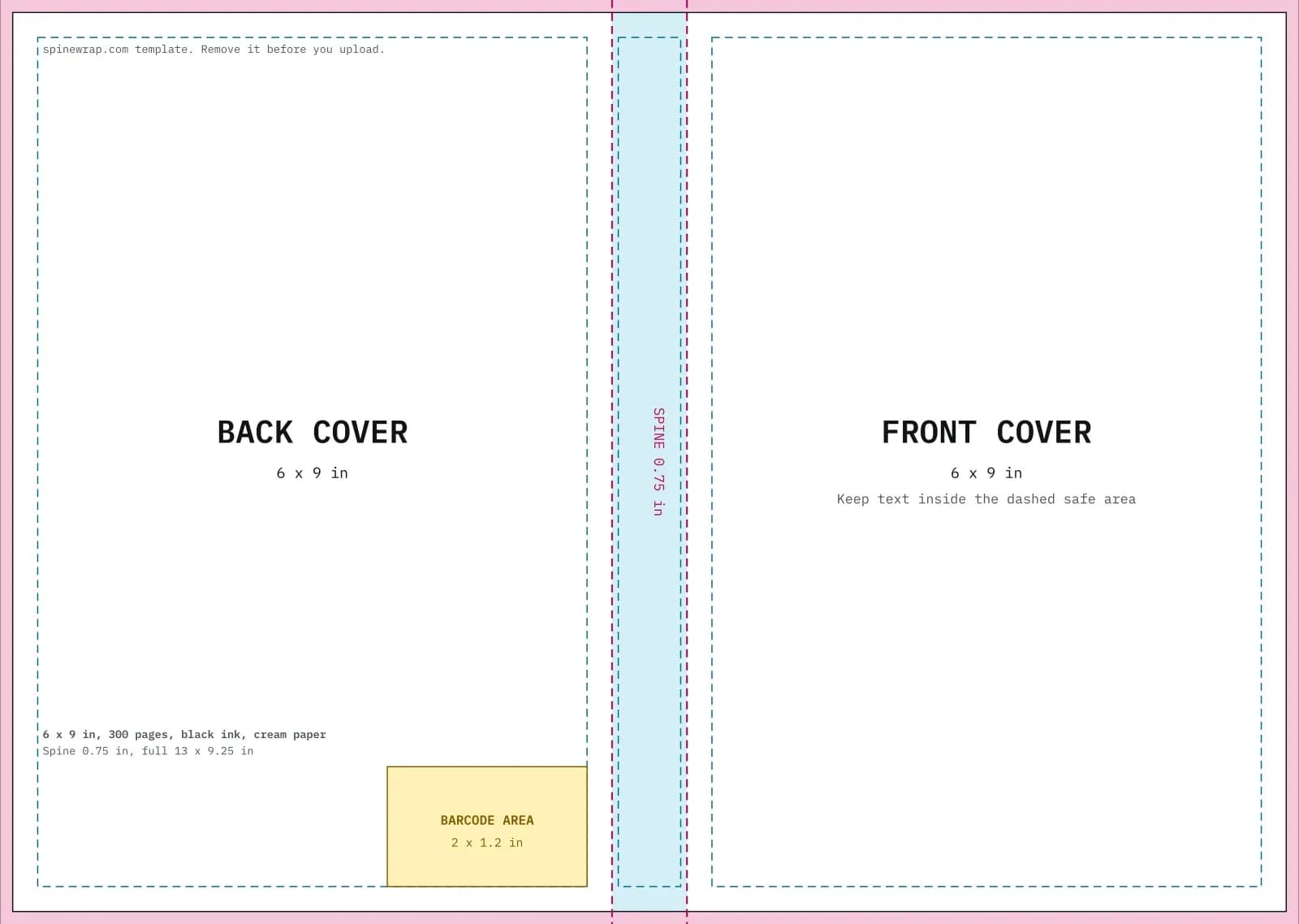
We built this file with the same code the tool on this page uses, from the public domain text of The Wonderful Wizard of Oz. So the image and the numbers below come from that run, not from a mockup.
- Test input
- 6 x 9 in, 300 pages, black ink on cream paper
- Output
- Cover template PDF and 300 DPI PNG
- Full cover
- 13 x 9.25 in
- Pixels
- 3900 x 2775 px
- Spine
- 0.75 in
- Spine text
- Allowed
- PDF size
- 13 KB
- Build time
- 309 ms
How we check files: a script compares every size with the KDP formula, and we open each PDF to check fonts, margins and the spine. More on the about page.
Cream vs white paper FAQ
Does cream paper cost more on KDP?
No. For black ink, KDP charges the same print cost for cream and white paper.
Can I print color on cream paper?
No. KDP offers premium and standard color only on white paper.
Which paper do most novels use?
Most novels use cream paper, because the warm tone is easier on the eyes for long reading.
Do I need a new cover if I switch paper?
Yes. The spine width changes, so make a new template and move the spine text to match.